

“A human being should be able to… balance accounts.”
— Robert A. Heinlein, Time Enough for Love
⚠️ Legal Disclaimer
This is not financial, investment, or legal advice. The author is not a licensed financial advisor. Consult a qualified professional for personal decisions. This post discusses historical patterns and philosophical frameworks—not specific strategies or product recommendations.
Let’s retire the theater.
Your bank promises safety.
Your government insures your deposits.
Your fixed-term account guarantees a return.
But here’s the brutal truth no one tells you:
“Guaranteed” doesn’t mean “preserved.”
It means “predictably and slowly eroded.”
🆕 New here?
food&arms isn’t about fear, gear, or survivalism. It’s the daily practice of freedom—through food, thought, and action.
→ Start with our manifesto: What Is food&arms? (And Why It’s Not What You Think)
What Is a Fixed-Term Deposit? (And Why It Exists)
Around the world, it goes by different names:
- U.S.: Certificate of Deposit (CD)
- UK/EU: Fixed-term savings account
- LatAm: Depósito a plazo fijo
- Asia: Time deposit
The promise is quite simple:
“Lock your money away for X days/months/years. We’ll pay you Y% interest. Your principal is safe.”
Sounds reasonable.
Sounds responsible.
Sounds… safe.
But safety is a spectrum, not an absolute —and bank safety ≠ personal sovereignty.

The Hidden Tax: Inflation Doesn’t Ask Permission
Here’s what banks don’t emphasize:
Interest rates are set by central banks. Inflation is set by policy.
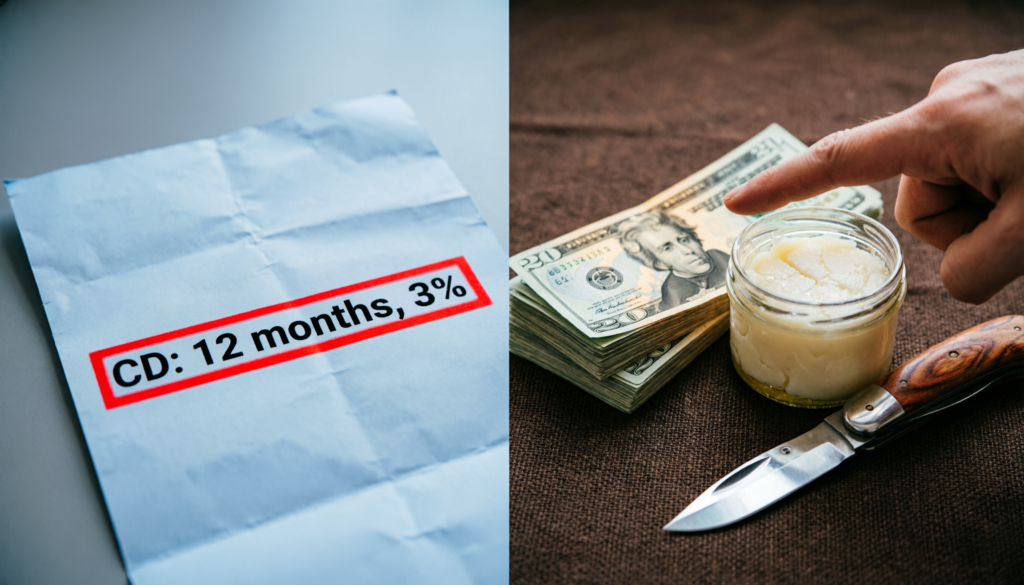
When your CD pays 3%…
…but inflation runs at 5%…
…you’re not earning 3%.
You’re losing 2%—guaranteed.
This isn’t market risk. It’s systemic erosion.
Historical Reality Check:
- 1970s U.S.: CDs paid 15%. Inflation hit 13%. Real return: 2%.
- 2008–2015: CDs paid 0.5–1%. Inflation averaged 2%. Real return: -1% to -1.5%.
- 2020–2024: CDs briefly hit 5%. Inflation peaked at 9%. Real return: -4%.
The pattern is clear:
“Guaranteed returns” are often guarantees of loss.
Why Banks Offer This (The Real Incentive)
Banks aren’t charities.
They’re businesses—and your locked-up money serves their liquidity needs, not necessarily your sovereignty.
When you commit to a 12-month CD:
✅ The bank can lend that money at higher rates
✅ You can’t withdraw it (without penalties)
✅ You become a predictable source of capital
This isn’t evil. It’s just business.
But when confusing their incentive with your readiness is the mistake.
The Sovereignty Gap: Liquidity vs. Illusion
True financial readiness has three pillars:
🥇 1. Liquidity
→ Can you access your resources when systems fail?
→ A CD locked for 12 months isn’t liquid. It’s hostage to the system.
🥈 2. Preservation
→ Does your “savings” actually preserve buying power?
→ If inflation outpaces interest, you’re not preserving—you’re participating in your own erosion, just at a slower pace than if you put the money under your matress.
🥉 3. Control
→ Do you decide when and how to use your resources?
→ Or does a penalty schedule decide for you?
Most fixed-term accounts score zero on all three.
What Real Readiness Looks Like (A Philosophical Framework)
This isn’t about “investing.” It’s about understanding value.
🔸 Tangible Assets > Digital Promises
- Skills you can trade (cooking, fixing, teaching)
- Food you can eat or barter
- Tools you can use or lend
- Knowledge you can share
These can’t be inflated away.
They exist outside the system.
🔸 Liquidity > Yield
A 0% return in cash you control is better than a 5% return you can’t access.
Why?
Because freedom to act beats theoretical gain.
🔸 Diversification Beyond Digits
Don’t just diversify within the financial system.
Diversify outside it:
- Physical goods
- Community networks
- Practical skills
- Land (if accessible)
This isn’t paranoia. It’s prudence.
The Citizen’s Alternative: A Framework, Not a Formula
I won’t tell you percentages. I’ll offer a way to think:
Think in Buckets, Not Balances
Instead of one savings account, imagine three buckets:
- Immediate Access (0–3 months)
→ Cash you can grab today
→ For real emergencies (car breaks, medical, job loss)
→ No penalties. No waiting. - Tangible Readiness (3–12 months)
→ Skills, pantry, tools, community
→ Things that work when money doesn’t
→ No inflation. No erosion. - Long-Term Stores (1+ years)
→ Assets outside the immediate system
→ Knowledge, land, heirloom seeds, durable goods
→ Preservation through independence.
This isn’t a portfolio. It’s a readiness architecture.
The Dark Side: When “Safe” Means “Compliant”
There’s a subtle danger in fixed-term thinking:
It trains you to outsource your judgment.
When you accept “guaranteed” returns without questioning inflation…
When you lock resources without considering access…
When you trust systems without building alternatives…
…you’re not being prudent. You’re being compliant.
And compliance, in a fragile world, is the opposite of freedom.

Why This Matters for food&arms Readers
You don’t read this blog for finance tips.
You read it because you believe:
Freedom is built daily—in small acts of competence.
Your kitchen sovereignty matters.
Your physical readiness matters.
Your mental clarity matters.
And your financial literacy matters too—not because you want to get rich, but because you refuse to be fooled.
The idea behind a person being able to “balance accounts” is not to maximize ROI, but to understand systems well enough to remain independent of them.
That’s the goal here.
Final Orders
- Review your “safe” accounts.
→ What’s the real return after inflation?
→ How quickly can you access it?
→ Who controls the terms? - Build one tangible asset this month.
→ A skill you can trade
→ A pantry item that stores for years
→ A tool that solves real problems - Ask yourself:“Does this preserve my freedom—or just my compliance?”
Because sovereignty isn’t found in guarantees.
It’s found in the quiet certainty that you understand the game—and refuse to play by rules that erode you.
Now go build something that lasts.
(Your future self will thank you.)